
The Significance of B5G Research and Development
Toward Beyond 5G Achievement: the Future Potential of HAPS Flying Base Stations
Yoshihisa Kishiyama
Space RAN Business
Space Compass Corporation
To achieve the Beyond 5G paradigm, it is essential to build non-terrestrial networks(NTNs) that include land, sea, air, and space, and, in this connection, HAPS (high-altitude platform stations), which are also known as flying base stations, have attracted attention as technology for achieving ultra-wide-area connective communication. Recently, Mr. Yoshihisa Kishiyama of Space Compass, which promotes HAPS research and development, talked to us about the current development situation, upcoming initiatives aimed at social implementation, and the future role that HAPS are expected to play in a Beyond 5G society.
HAPS: Delivering-Ultra-Wide Area, High-Capacity Connectivity from the Stratosphere
Please tell us about the Space Compass vision as well as your current mission.
Kishiyama:
Space Compass is a joint venture that was established by NTT and SKY Perfect JSAT in July of 2022. Its vision is to achieve a space integrated computing network . More specifically, Space Compass aims to help achieve a world that is connected regardless of time or place by non-terrestrial networks (NTNs) that include geostationary orbit (GEO) satellites, low Earth orbit (LEO) satellites, and HAPS, in addition to terrestrial networks. In terms of these efforts, I am personally in charge of implementing communication services using HAPS, and the purpose of this project is to develop related technology.
Exactly what kind of technology is used by HAPS?
Kishiyama:
HAPS are platforms achieved by equipping aircraft flying in the stratosphere (at an altitude of approximately 20 kilometers) with communication equipment. One major feature of HAPS is that, because they are closer to the ground than geostationary orbit (GEO) satellites or low Earth orbit (LEO) satellites, they can provide direct connections to smartphones for low-latency, high-speed, high-capacity communication. In addition, unlike low Earth orbit (LEO) satellites, HAPS can hover in place, which makes them suitable for stable communication service and fixed-point observation.
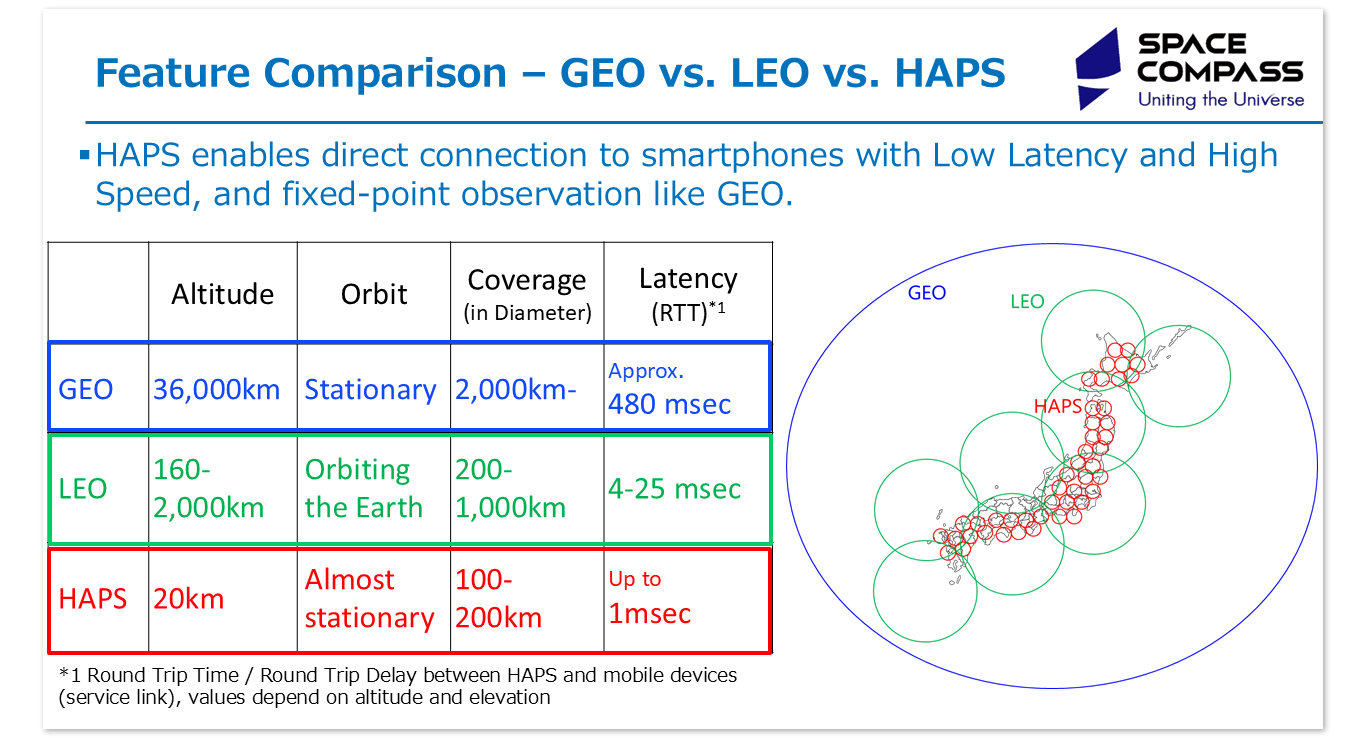
(source: Space Compass, ©AALTO HAPS Limited)
HAPS are an extremely important element of non-terrestrial networks (NTNs), which are viewed as a vital foundation for Beyond 5G. HAPS play a key role in shoring up the weaknesses of terrestrial networks, such as during disasters, when they can be used to maintain a connection from the sky even if communication infrastructure is destroyed due to their ability to communicate with mountainous areas and remote islands, which are difficult for terrestrial communication networks to reach.
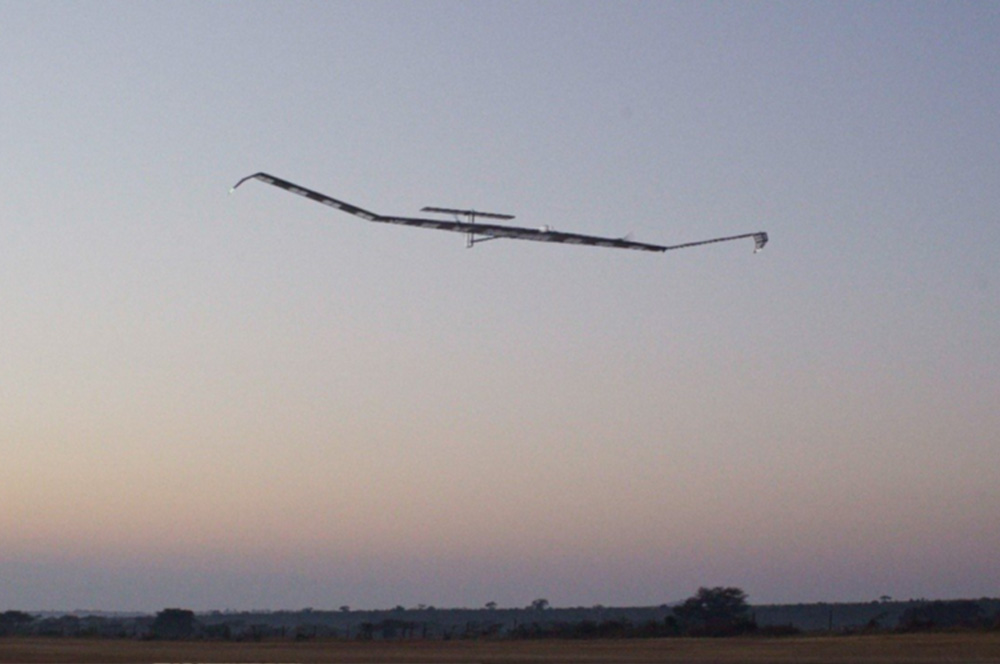
There are two types of HAPS aircraft: floating types that use light gas, such as balloons and airships (the buoyancy using type), and types that have their own propulsion, such as gliders (the fixed-wing type), but we use the Zephyr (made by AALTO HAPS Limited), a small fixed-wing aircraft. The Zephyr has a wingspan of 25 meters, a weight of approximately 75 kilograms, and a system that achieves propulsion by using solar cells. In 2025, the Zephyr flew for 67 days in a row, which was a record for unmanned aerial vehicles.
(source: Space Compass, ©AALTO HAPS Limited)
World’s First Successful Data Transmission to User Devices via a Fixed-Wing HAPS Flying Above 18 km
In February of 2025, you successfully communicated data through HAPS. Please tell us a bit about that.
Kishiyama:
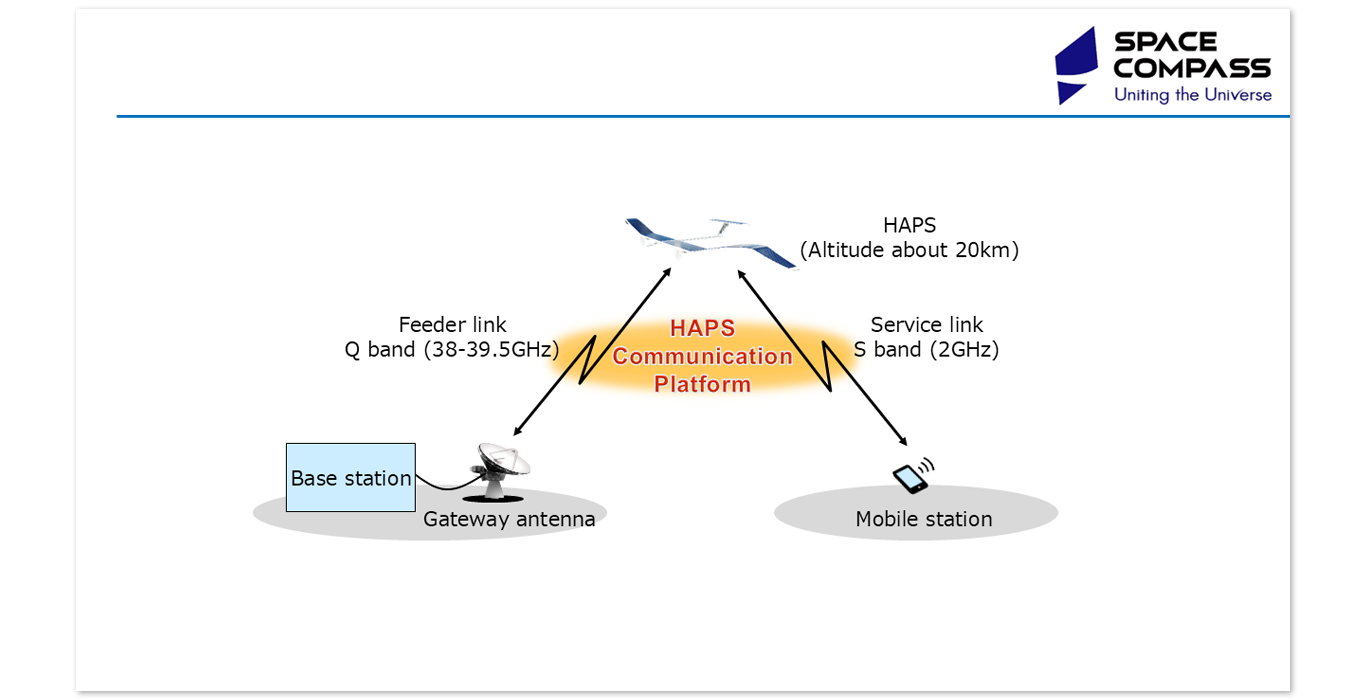
There are two types of HAPS communication system: the regenerative relay architecture, which involves equipping HAPS with base-station functions, and the bent pipe architecture, which involves using HAPS to retransmit radio waves, but—in the interest of achieving implementation as soon as possible—we used the bent pipe system to conduct a demonstration experiment in Kenya. We chose Kenya for this experiment due to the stable climate during the dry season, which made it optimal for flying fixed-wing HAPS given that such aircraft can easily be affected by rain and wind. During the experiment, we successfully flew a HAPS aircraft in the stratosphere, transmitted radio waves from a gateway station connected to an LTE base station set up on the ground, and used them to deliver data to a terrestrial mobile device through the HAPS platform. (See Figure 2.)
I believe that, as a result of this experiment, our work attracted attention as the world’s first example of successfully achieving wireless communication through HAPS, and our results also show that Beyond 5G technology has gone from the research stage to a stage closer to actual usability. We also plan to start a demonstration experiment in Japan.
Although there are many challenges involved in bringing the aircraft launched in Kenya into Japanese airspace, we are working diligently to overcome them.
What kind of technology is necessary to achieve commercialization?
Kishiyama:
Because the fixed-wing HAPS (bent pipe architecture) used for this project continuously circling in the sky, the direction of radio waves to the target may vary, and the frequency may shift due to changes in distance. Therefore, we applied a technology that always delivers radio waves to the target location (beamforming) and a technology that automatically compensates for the frequency shift (Doppler shift). Such technology is necessary for stable communication.
In addition, to achieve commercialization in Japan, it is also essential to consider the effects of high-frequency (millimeter wave) attenuation due to rain and clouds, which means it is necessary to design communication links that secure stable performance. We are therefore promoting link design based on estimates derived from domestic observation data, including remote islands.
Another one of our future goals is to increase the communication capacity so that as many people as possible can simultaneously use through a single HAPS. In the future, we hope to achieve multi-beam irradiation and optimal beam selection control for a single HAPS platform to increase capacity so that, for example, three HAPS can be used to cover the entirety of Okinawa, and, more generally, wide regions can be covered using fewer aircraft. To overcome the propagation-distance limitations of the bent pipe architecture, we are also developing on-board equipment for the regenerative relay architecture, which will enable the HAPS itself to play the role of a base station, thereby expanding the service area. This involves taking on the challenge of increasing the performance as much as possible while clearing requirements related to the load carrying capacity and power consumption. By adopting this regenerative relay architecture, HAPS can interoperate with satellites and use satellites as backhaul links, thereby would providing communication service even if there is no terrestrial base station. This kind of communication network, which truly integrates air, space, and land, will only be possible in the Beyond 5G era.
The Future Communication-Based Society Achieved by HAPS
What kinds of applications will HAPS conceivably be used for?
Kishiyama:
In particular, HAPS are expected to be applied to the use cases below.
The first assumed use case is disaster countermeasures. When earthquakes, typhoons, or other disasters strike, even if the terrestrial communication infrastructure is destroyed, HAPS can maintain communication coverage from the stratosphere, which will make it easier to ensure communication in disaster areas. Because HAPS are equipped with solar cells, they can be used to promptly collect information and ensure communication with mobile phones in disaster areas without waiting for the power to be restored. This is expected to contribute to improving the efficiency of long-term rescue operations, ensuring that communication methods are available, etc.
The second assumed use case is communication-area expansion. At the present time, Japan’s mobile communication infrastructure covers almost 100% of the population but only around 60% of the area. The remaining 40% includes mountainous areas and remote islands, but using HAPS could enable us to provide high-speed, stable communication even in areas where no communication infrastructure has been established, which would help us achieve a society that is fully connected everywhere.
The third use case is remote sensing. HAPS can be utilized not only for communication but also for remote sensing via fixed-point observation. This could potentially be used for a wide range of industries, including collecting weather data and managing large-scale farms.
What kind of role will HAPS play in a Beyond 5G society?
Kishiyama:
I believe that HAPS will play an extremely important role in the Beyond 5G era.
These three use cases I mentioned earlier are of course important, but, in a Beyond 5G society, not only people but also machines will be connected at all times, and both our lifestyle and industrial structure are expected to change dramatically. Therefore, in addition to conventional communication, I think sensor technology will be further developed and we will see progress as an IoT society in which things are connected to the Internet. I believe that HAPS will serve as a foundation for communication related to drones, robots, and self-driving cars, which will make our lifestyle considerably more convenient and safer.
In addition, we can expect the creation of new IoT services. I think we will see examples of utilization that we never thought possible, including a wider communication scope, increased efficiency in agriculture, logistics, and medical fields thanks to real-time data collection over wide areas, and new kinds of entertainment and educational services in regions that were once outside of communication areas.
A message from Mr. Shigehiro Hori, Co-CEO of Space Compass
Beyond 5G is more than just high-speed communication. It is in fact the foundation of a new society. Regarding the Beyond 5G paradigm, HAPS are a major innovation in terms of going beyond the limits of existing communication infrastructure. In spite of the decreasing population, by utilizing air and space, I believe that Japan can achieve a society that enables everyone to enjoy uninterrupted communication even during disasters, on remote islands, or in mountainous areas, and this approach can be applied all over the world as well.
During the research and development period up through fiscal 2027, we will achieve increased sophistication by demonstrating suitable wireless technology. After that, we will continue taking on challenges that include working on the social implementation of HAPS as a system, implementing new infrastructure under which it is perfectly normal for HAPS aircraft to fly, and building the necessary systems.