

The Significance of B5G Research and Development
Beyond 5G: How Will the Evolution of This Information and Communication Infrastructure Be Leveraged in the Future?
Hiroyuki Morikawa, Ph.D. (Engineering)
Professor, Electrical Engineering and Information Systems
Graduate School of Engineering
The University of Tokyo
Professor Hiroyuki Morikawa specializes in fields that include wireless communication, IoT, and information networks. And he serves as Chief Investigator of the New-generation Mobile Communications System Subcommittee, which is part of the Ministry of Internal Affairs and Communications Information and Communications Council, the Co-Head of the Beyond 5G New Business Strategy Center, and the Co-Chairman of the XG Mobile Promotion Forum. As a Beyond 5G promoter, he actively works to connect industry, academia, and government. With these his roles in mind, we asked him how he views the current situation of Beyond 5G research and development as well as what his predictions are regarding society after Beyond 5G is achieved.
“Beyond 5G” Removes the Constrains of Location and Device
How do you define “Beyond 5G”, and what kind of society do you imagine after this paradigm is achieved?
Morikawa:
The Ministry of Internal Affairs and Communications explains “Beyond 5G” as our next generation of digital infrastructure (figure 1), but, to put this into my own words as simply as possible, I believe “Beyond 5G” is something way better than 5G. This was also mentioned when 5G was first introduced, but I think that constraints that we unconsciously accept as normal will be gradually eliminated.
Firstly, if “Beyond 5G” successfully connects people and things everywhere—including land, sea, and air—location-related constraints will be eliminated, and it will become possible to, for example, control construction machinery from remote locations. When attempting to recover from disasters, this will make it possible for construction workers to assist even without actually going to disaster-stricken areas, which will help to keep them safe. If all construction machinery across Japan can be operated remotely from an office, I expect that the number of construction workers will increase. Outside of the construction industry as well, I think that eliminating location-related constraints will dramatically change our work-style approach.
In addition, if “Beyond 5G” results in increased communication speed and reduced latency, I think that device-related constraints will also be eliminated. For example, in the case of current game consoles, the devices owned by players must perform high-speed processing and are therefore high-performance, heavy, and expensive, but, under the “Beyond 5G” paradigm, it will be possible to run games by using computational resources in the cloud—which is accessed via communication lines—to handle processing, which will mean the functions of gaming devices can be radically simplified. Both gaming and other devices will only require a display and communication module, which will make them lighter and affordable. I also believe that the way games are made will change. By handling processing on the other end of the communication line, it will no longer be possible to tamper with programs on the device side or to exploit bugs to cheat and gain an unfair advantage at games. Data synchronization will also become easier, and I feel like this will have a profound impact on the gaming industry.
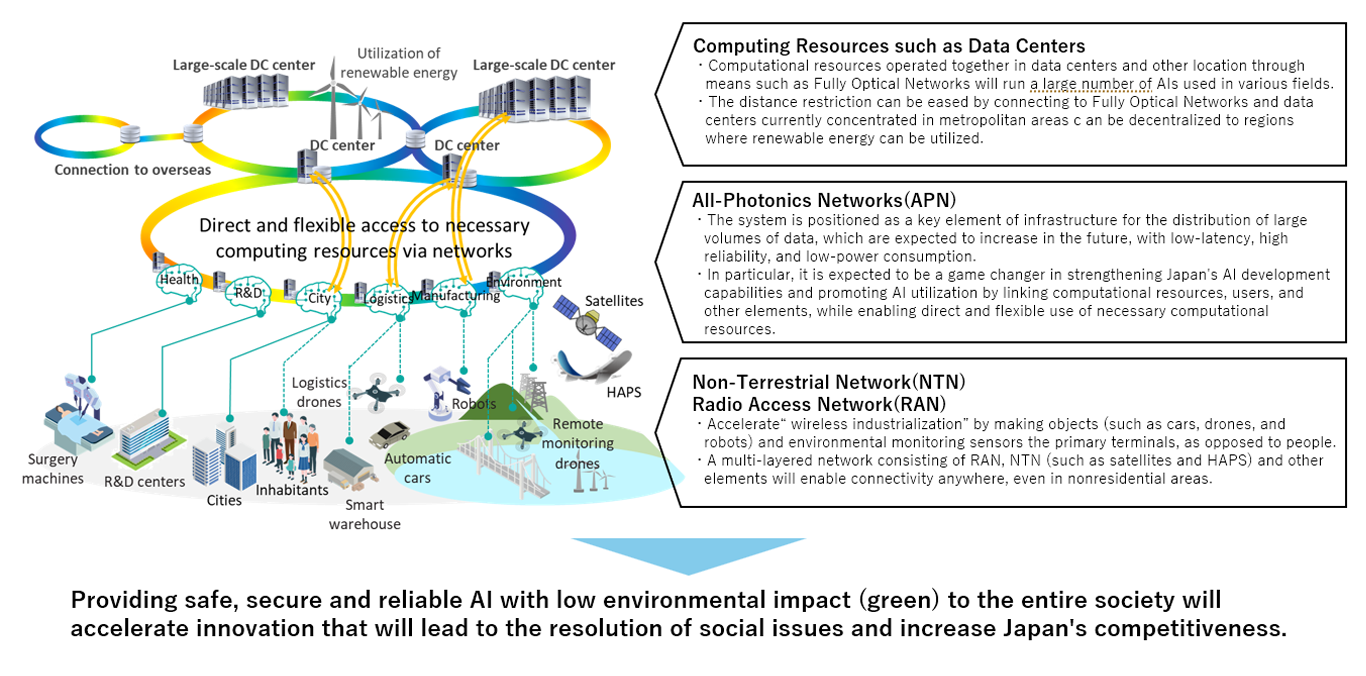
Source: https://www.soumu.go.jp/menu_seisaku/ictseisaku/B5G_sokushin/index.html, Ministry of Internal Affairs and Communications website
What are the key technologies for achieving Beyond 5G?
Morikawa:
Generally speaking, I believe there are two such technologies. The first is AI-native wireless communication technology. At this point, we are seeing a natural overall tendency for AI and wireless communication technology to collaborate. Utilizing AI to control the various stages of communication leads to increased efficiency, energy savings, and reduced costs. I think this is especially important in terms of implementing 6G.
The second key is optical network technology. Most people seem to think that their smartphones wirelessly connect directly to other smartphones, and few people have an awareness of the existence of optical networks between base stations beyond wireless link, however, to achieve the high-speed, low-latency communication promised by “Beyond 5G”, it is important to expand optical networks and improve the related technology. Japan has always been strong in this field, so I hope that everyone will work hard on this to contribute to increasing our country’s international competitiveness as well.
Hurdles Between Value Creation and Value Capture
How do you view the situation of the technological development for “Beyond 5G” era?
Morikawa:
I feel like we are making steady progress on achieving more advanced communication infrastructure, including wireless communication and optical networks. However, it is unfortunately still not clear how this technology will be used or how society will change as a result. The prediction I mentioned earlier about location and device-related constraints being eliminated has been around since before 5G appeared, but we have still not achieved this. This is not simply a personal prediction, and there were in fact extremely high expectations surrounding 5G, but things did not turn out as great as everyone hoped. This situation has continued since then, and I suspect that we have to put up with some challenges now for better things later. I genuinely believe that, if we can build good communication infrastructure, people will come up with various ideas as a result.
In other words, there has not been much progress in terms of using developed technology. Why do you think that is?
Morikawa:
I suspect that it is more difficult to associate technology with business now than it was in the past. In the past, developed technology would naturally find itself into society at some point, but, nowadays, even after developing technology, there are high hurdles in the way of commercializing and monetizing it, and it has become more common to get bogged down in research for the sake of research.
Regarding 5G as well, although there have been various demonstration experiments and other initiatives aimed at utilization in industrial fields, most of these have ended with simply learning that 5G technology is in fact usable and never led to actual implementation. I call cases such as this PoC (proof of concept) corpses.
Business administration is said to consist of two overall tasks: value creation and value capture. Value creation is when one gains the ability to do something that was not possible until now. In other words, the creation of new technology is an example of value creation. Meanwhile, value capture is when such technology is released to society and results in the ability to earn money, but it feels like the hurdles between value creation and value capture have become much higher than before. Perhaps the high level of society’s maturity has made social implementation more difficult.
What should be done to overcome such hurdles?
Morikawa:
To put it in abstract terms as always phrased by Professor Ikujiro Nonaka, a business scholar who passed away in 2025, I believe we must engage in wholehearted intellectual combat. Innovation is ultimately made possible by intellectual combat engaged in by people in various positions as they find ways to empathize with each other’s topics.
For example, if engineers and marketing representatives working at a company enjoy psychological safety—which means that they are not worried about their opinions being rejected or criticized—and engage in open discussions, when it comes to technology that is merely demonstrated and then ends up as a PoC corpse, marketing representatives are likely to ask whether the technology is really necessary and whether there are actually customers who will pay for it. The engineers will likely be shocked by such questions, but they will also consider the fact that there are no customers and then re-evaluate how to proceed. When engineers find themselves in a comfortable place, they tend to focus on developing only what they like, so there is a risk of them ending up with something that has no customers when it comes time to think about implementation. It is therefore important for them to hold discussions with people in various positions, including marketing, sales, public relations, and intellectual property, and—unless there is ongoing intellectual combat of this sort—I do not believe there will be any progress towards implementation.
For “Beyond 5G” era, Both Technology’s Creators and Users Play a Leading Role
What kinds of things do you think are necessary to achieve the social implementation of “Beyond 5G”?
Morikawa:
In terms of achieving “Beyond 5G”, the question of how we go about building commercialization and monetization systems is vital. As an example, communication system that goes beyond 5G capabilities is necessary to realize fully automated driving, but, if we successfully achieve level 4 fully automated driving, even elderly people in rural areas will be able to freely get around on their own, and it will no longer be necessary for municipalities to run public buses that have few passengers, which means such technology has a lot of value. Therefore, although I am not sure whether the communication fees will ultimately be paid by automobile companies, municipalities, or users, it seems necessary to change the mindset for the communication system-fee until now.
Of course, it is also necessary to make it possible for communication-system developers to make good systems that provide users high value in line with the communication fees. However, given that users—including communication carriers—tend to adopt a wait-and-see approach, it is difficult to predict how large a market will form for using a newly developed communication system, so there are risks involved in such investment. This is why there is so much significance in the government covering research and development costs for next-generation communication systems.
Do you believe that Beyond 5G will help to usher in a future that goes beyond simply remove constrains of location and device as you mentioned at the beginning of this interview?
Morikawa:
I believe so, but I am not sure what kind of future it will be. One example I always use is that of the washing machine. Washing machines significantly reduced the amount of housework people had to do and were therefore an innovation that had a major impact on society, but this was not the only social effect they had. As a matter of fact, the use of washing machines also changed everyone’s sense of hygiene, and, once people started changing their clothes every day, the clothing market expanded.
Another example is personal computers. Computers transformed various kinds of work, including document creation and calculations, but this was not the only impact they had on society. As a result of the spread of computers, various markets emerged around them, including the cloud and network security markets. However, when computers first appeared, no one predicted such changes.
I therefore have a feeling that “Beyond 5G” will also have effects that no one is currently imagining. “Beyond 5G” has all kinds of potential, so—if we create the circumstance to develop it and then support people who are passionate about it—something will definitely grow. I think that this fund is crucial in terms of fulfilling this kind of role.
In addition, looking ahead to the future practical deployment of “Beyond 5G”, this fund needs to take steps that include having various members with business sense participate at the project adoption stage to help achieve social implementation. In this sense, the running of organizations such as US Ignite, which includes not only technical experts but also public relations experts, community managers, and various other professionals engaged in running the project, could serve as a good example for us.
I believe that each individual creator (implementer) and user plays a leading role in the realization of “Beyond 5G”. Given that we can create something way better than 5G, I hope that we can consider what kind of future we can achieve by using “Beyond 5G” together.