

The Significance of B5G Research and Development
Aiming to Realize Medium- and Long-Range Wireless Communication Underwater
Yuki Fukumoto, PhD (Engineering)
Executive Vice President, Kyushu Institute of Technology
Director, Innovation Headquarters / Specially Appointed Professor
Conventionally, underwater and undersea communication has generally relied on acoustic communication. We asked Principal Investigator Dr. Fukumoto about the achievements of a project aimed at establishing medium- and long-range wireless communication technologies by challenging the preconception that “wireless communication using radio waves is impossible underwater or undersea.”
Achieving results surpassing project goals
Please tell us about the purpose, current status, and results of the project “Research and Development of Wireless Communication Technologies for Undersea and Underwater IoT,” which was conducted in collaboration between Kyushu Institute of Technology and Panasonic Holdings Corporation.

Fukumoto:
This R&D project was conducted over four years from 2021 to 2024 as a commissioned research project under the Innovative ICT Fund Projects for Beyond 5G (6G) of NICT (National Institute of Information and Communications Technology).
Conventionally, acoustic communication - using sound waves - has been the norm for undersea communication, and radio waves were generally not used. There was a preconception that radio waves do not propagate underwater, especially undersea. Although some research has been conducted, it was not at a level aimed at practical application.
Conversely, there is a growing demand for undersea IoT in fields such as the construction and maintenance of undersea structures and support for the aquaculture industry. Currently, these tasks rely on divers working undersea, but if they could be replaced by undersea drones or robots, various benefits would arise, such as long-term, low-cost video recording at aquaculture farms and the collection of underwater data for equipment maintenance. To achieve this, the realization of medium-range and long-range wireless communication undersea is required.
At the start of the project, we set three goals, envisioning applications for the remote control and data transfer of undersea machinery and data collection from undersea sensor arrays.
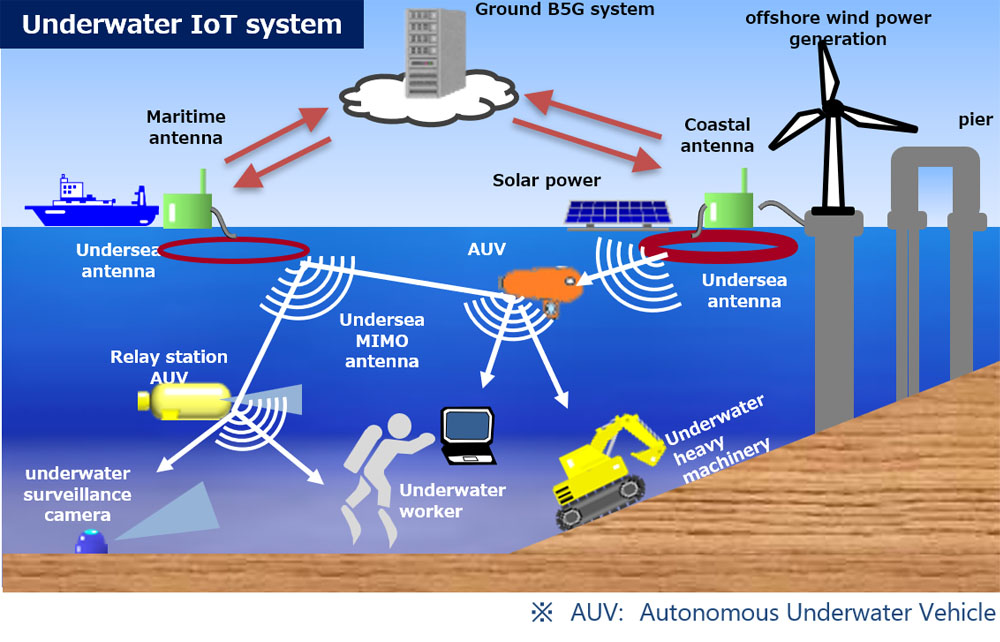
The first is the realization of “medium-range communication (1 Mbps over a maximum of 4 meters)” using innovative underwater antennas to connect IoT devices and access points.
The second is the realization of “long-range communication (10 meters or more, 10 or more multi-hops)” to connect land and underwater networks using underwater drones or similar devices as relay stations.
The third is the achievement of “international standardization” for undersea wireless communication technology. By the end of the project, we achieved results surpassing the initial targets for all goals, achieving 40 meters with 10 hops for long-range communication.
What are the differences from technologies up until 5G?
Fukumoto:
Until 5G, the focus was on advancing higher speeds and lower latency in communication. However, in this research on undersea wireless communication, we aim to establish technologies that expand the domain of communication to underwater and undersea environments - similar to communication from space - and establish NTN (Non-Terrestrial Networks). I believe the direction is different from the path taken up to 5G.
Expanding undersea wireless communication from point-to-point to surface coverage
How close are you to the use cases envisioned at the beginning of development? Also, what are the challenges for the future?
Fukumoto:
Currently, maintaining the undersea sections of offshore wind power generation facilities requires divers to dive down, necessitating a halt in power generation during the work. Similarly, at aquaculture farms, there are requests to be able to check the condition of fish at the bottom of the nets and whether they are swimming energetically via video, but currently, the only option is for divers to descend to the seabed and record video. If surface coverage becomes possible in undersea wireless communication, we believe these problems can be resolved.
In this project, we have achieved the goal of undersea wireless communication between fixed antennas. However, for actual monitoring of aquaculture farms and similar tasks, one of the antennas must be a mobile object. In other words, we need to evolve from point-to-point communication at fixed locations to surface communication that handles movement in all directions. We are proceeding with a new project to overcome this challenge and are working towards the goal of creating a wireless communication zone covering a planar area undersea by around 2030.
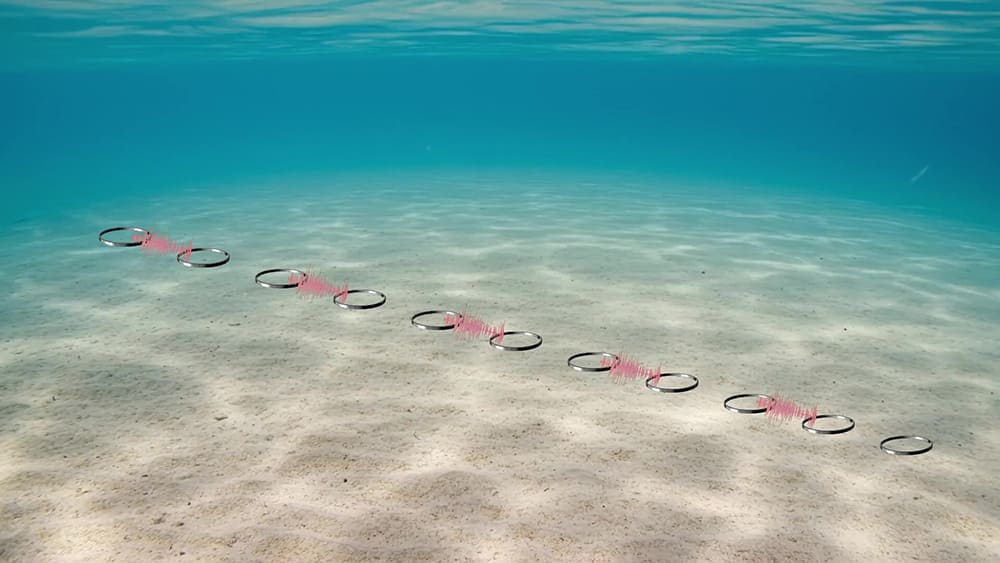
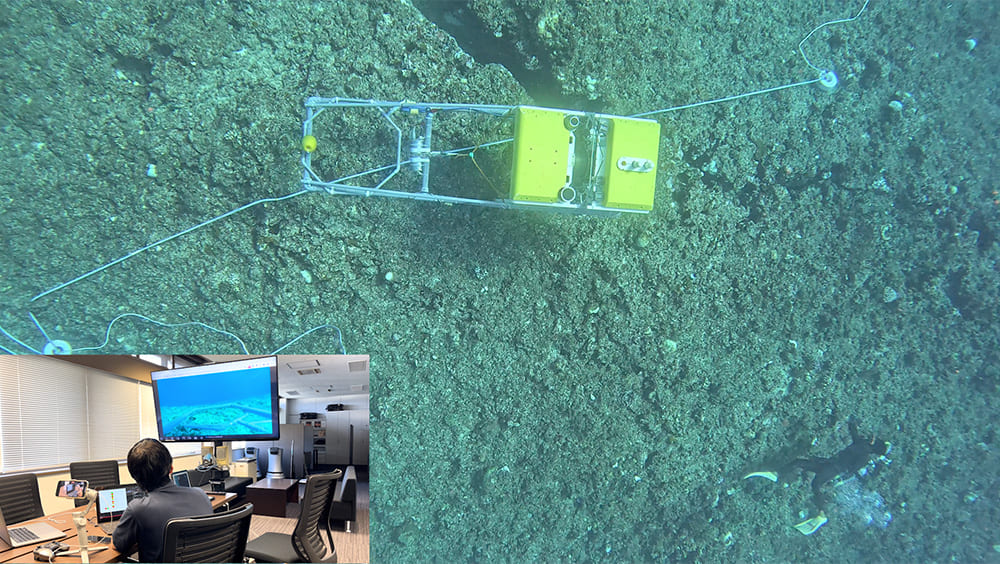
One challenge is dealing with the problem of electromagnetic noise. In this project, we installed antennas at 4-meter intervals for long-range communication, but if we attach an antenna to a robot, noise is generated, affecting communication speed. In undersea wireless communication, we use wideband communication at low frequencies that were not conventionally used, in a frequency band where noise regulations are not so strict. This presents a problem of low-frequency, wideband noise not envisaged in terrestrial communication. This problem is serious and likely cannot be solved with standard noise mitigation techniques. However, we have ideas for improvement, such as upgrading robots and developing communication systems that detect and avoid noise, so we intend to proceed with R&D while testing these measures in the future.
In addition, research on undersea wireless communication incurs enormous costs for even a single experiment. Since significant initial investment is required, it is a difficult field for startups. Even for a PoC (Proof of Concept), a large budget is often required depending on the application, making financial resources a hurdle. Conversely, however, I believe that if we can break through that barrier, we can generate strengths that no other country can match.
Among the anticipated effects of a Beyond 5G-enabled society, are there specific areas or technologies you particularly prioritize or have high expectations for?
Fukumoto:
Naturally, I have high expectations for my own field of research. Applications and technologies advance by stimulating one another, but it is common for one to stall. I believe that by aiming for “horizontal expansion,” such as expanding the service area, innovation is more likely to occur.
This research focuses on undersea wireless communication, but “horizontal expansion” - expanding the range of applications - is crucial to broadening its utility. Although there are greater technical challenges for seawater applications compared to freshwater ones, we anticipate numerous uses. Divers typically descend to around 50 meters, but undersea cables and structures are installed at much greater depths. If we enable the remote operation of undersea robots at these depths, maintenance of almost all undersea structures becomes feasible. If we can develop applications, such as maintenance tools for divers or safety measures for undersea cables, while simultaneously extending the wireless communication range, the potential uses will expand significantly as both technology and applications advance together.
While startups are typically considered strong in app development, I wouldn’t say that app development is currently a strong point for Japan. As an engineer myself, and also from a management standpoint, I hope to spark innovation in undersea communication.
Instilling a sense of urgency and accountability in industry-academia collaboration
Do you have any expectations or concerns regarding industry-academia-government collaborative research in Japan?
Fukumoto:
Having engaged in corporate research in the past and currently conducting research at a university, I can view the situation from both perspectives. However, I can hardly say that industry-academia collaboration is undergoing a drastic transformation.
From the academic side, my impression is that universities are not fully committed to the output of industry-academia collaboration. Perhaps due to a lack of trust in academia from the industry side, corporate investment tends to be limited. Consequently, for substantial funding, there is a tendency to rely on the government. Compared to overseas, the reality is that the sense of urgency and mutual accountability between industry and academia is low. This may also be due to cultural differences.
In this project, Kyushu Institute of Technology and Panasonic clarified the division of roles and the scope of joint work in advance. We also built a collaborative framework by establishing a project office for Kyushu Institute of Technology within Panasonic and having researchers from the university stationed there. I believe we established a solid collaborative structure in an environment conducive to open communication. Of course, we also share the results of the project.
Generally speaking, I think it is necessary to consider industry-academia collaboration from three perspectives. The first is “technology procurement” from academia by industry. I think this is the form of industry-academia collaboration that many people envision. The second is “personnel exchange.” This is where industry seeks talent from academia, and industry-academia collaboration overseas often seems driven by this intent. Of course, two-way personnel exchange is also beneficial. And the third is “policy collaboration.” From the standpoint of industry, engaging directly with the government presents high hurdles, so there is an expectation that academia can serve as a conduit – an intermediary – to the government. I think that is also one of the purposes of industry-academia collaboration in government-funded projects. These three do not carry equal weight, and it will be necessary to proceed while discerning where each party’s true intentions lie.
What do you consider important for further utilizing the results of Beyond 5G research and development for the benefit of society in the future?
Fukumoto:
To expand Beyond 5G R&D results horizontally, startup support will become important. There are many public projects, including those by the Ministry of Internal Affairs and Communications, that provide funds to startups. However, since Deep Tech (*) related to communication infrastructure can take 10 or 20 years for results to appear, long-term funding is essential. Since many startup funds require shorter-term results, I believe a Deep Tech startup support scheme tailored specifically to such technological fields is necessary. There are projects targeting young researchers, but I hope that future initiatives will broaden to include extending support to students and university-launched startups.
*Deep Tech: Technologies with the potential to provide solutions to economic and social issues and have a significant impact on society.