

The Significance of B5G Research and Development
Aiming to Realize a Social System for Expanding Human Capabilities and Coexistence Between Humans and Robots
Masayuki Murata, PhD (Engineering)
Specially Appointed Professor (Professor Emeritus), Graduate School of Information Science and Technology / D3 Center, The University of Osaka
Director, NEC Beyond 5G Research Alliance Laboratories, The University of Osaka
NEC Beyond 5G Research Alliance Laboratories (hereafter, B5G Lab) at The University of Osaka was established in 2021 with the aim of constructing Digital Twins as a distributed data processing platform for Beyond 5G. By integrating advanced knowledge from fields such as information science (computing/networks), control engineering (robotics), and urban engineering, the B5G Lab seeks to utilize this platform to establish a society where humans and robots coexist. In addition, the B5G Lab is working on the advancement of Beyond 5G networks utilizing these results. We asked the Director of the laboratory, Masayuki Murata, about the philosophy, initiatives, and expectations for the Beyond 5G era.
An industry-academia collaborative research laboratory tackling four challenges
Please tell us about the background behind the establishment of the “NEC Beyond 5G Research Alliance Laboratories” at The University of Osaka and the priority areas the laboratory is addressing.
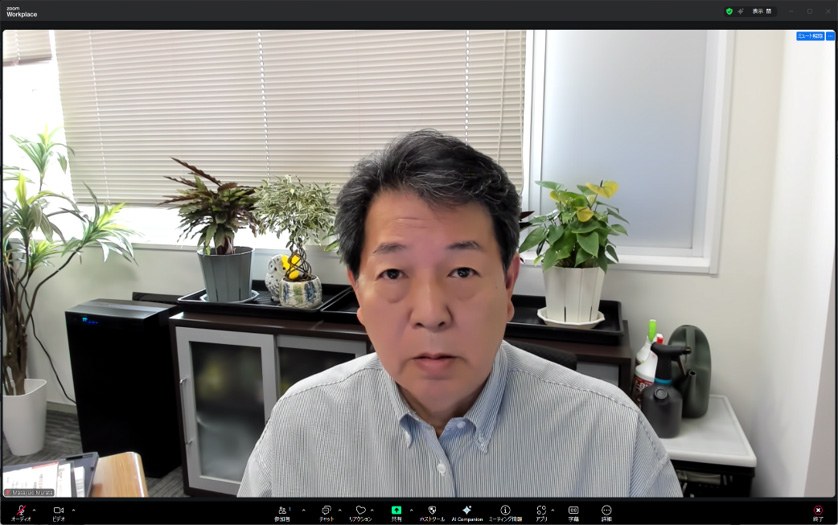
Murata:
The NEC Beyond 5G Research Alliance Laboratories (B5G Lab) was established under The University of Osaka’s “Research Alliance Laboratory” scheme to facilitate joint research on Beyond 5G between NEC and the university. The University of Osaka advocates “Industry on Campus,” and the laboratory was set up to develop joint research with NEC directly on the university campus. The University of Osaka’s industry-academia collaboration schemes include Joint Research Chairs and Research Alliance Laboratories, in addition to standard joint research between companies and university laboratories. Our Research Alliance Laboratory represents the largest of these industry-academia collaboration schemes.
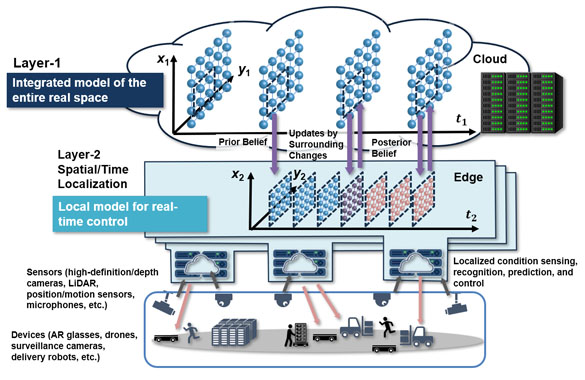
We initially established three research themes.
The first is the “establishment of digital twin technology and its application to real-time system control.” Unlike conventional digital twins used merely for virtual simulations, this provides a digital platform for controlling the real world – including communications – enabling us to handle the uncertainties of real-world environments. To this end, we are also working on technologies evolved from “brain-inspired information technology,” a field I have led for years.
The second is the “application of digital twins to real-time system control.” Specifically, we are focusing on the control of automated guided vehicles (AGVs) in distribution warehouses. Since the target environment involves the physical coexistence of humans and robots, maximizing human safety is crucial. Therefore, for robot motion control, we utilize centralized control via the network rather than standalone autonomous operation. We have focused our R&D on applications for AGVs, but I understand NEC is also applying this to forklifts and other equipment.
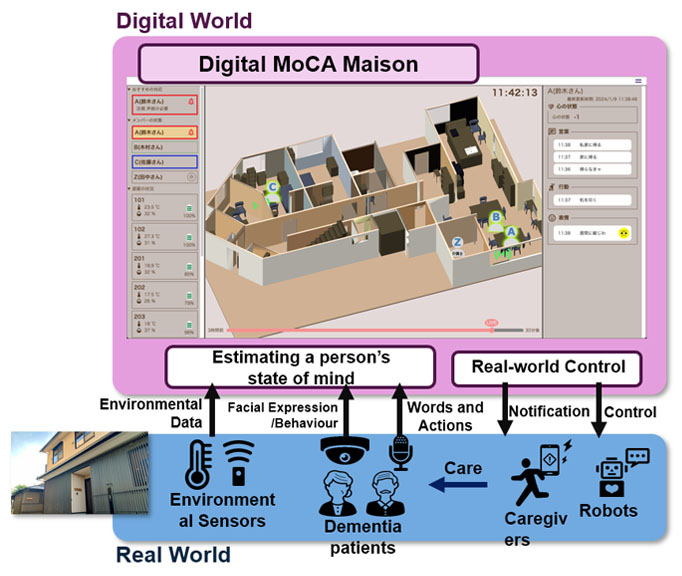
The third is the “improvement of well-being using IoT technology in nursing care facilities such as service-assisted housing for the elderly.” Our aim is first to improve the working environment for caregivers, and then to improve the living environment for patients. To achieve this, we have been conducting demonstration experiments on the mutual growth of digital technology and people’s actual daily lives using the “Living Lab” method at “Shibahara MoCA Maison” (Toyonaka City, Osaka Prefecture), an operating service-assisted housing facility for the elderly. Based on these results, our B5G Lab, NEC, and the Japan Montessori Care Association participated in the “Future Life Village” at Expo 2025 Osaka, Kansai, Japan for seven days starting on July 8, 2025 (Title: Dementia that brings happiness and shines people’s lives - If you get DEMENTIA -). We presented exhibitions on new dementia care and proposals for the future, and received a great deal of feedback from visitors.
Reference:https://resou.osaka-u.ac.jp/ja/story/2024/OURG-04-06
In addition to the above, we are currently working on “technologies for measuring B5G/6G communication quality environments, creating digital twins of these environments, and utilizing them to enhance network quality.” To address unexpected fluctuations in wireless communication quality (i.e., uncertainty), we are actively engaging in R&D on technologies such as adaptation to environmental changes, by monitoring communication quality in the physical environment and converting it into a network digital twin.
Let me briefly explain the application of “brain-inspired information technology,” which I mentioned as the first research theme, as this is a topic my team has been working on for many years. The human brain can be viewed as a system that makes appropriate judgments and determines actions instantly, based on uncertain observational information, even when there are errors in sensing information. Our research involves mathematically modeling this information processing mechanism of the brain and applying it to various systems such as networks. We call this “Fluctuation-Induced Control and Learning.”
To apply the aforementioned digital twin technology to actual systems, it is necessary to handle the uncertainties of the real world. To that end, we first proposed a “Probabilistic Digital Twin” that models the entire real world probabilistically. Furthermore, to realize this, technology is needed to identify various objects in the real world in real time and specify their positions. While video analysis using deep learning and other methods achieves very high recognition rates today, we utilize fluctuation-induced learning to process this data in real time. Of course, creating digital twins of all information in the real world presents scalability issues. Therefore, we have also been working on the hierarchization of Probabilistic Digital Twins by utilizing hierarchization technology enabled by edge computing.
Creating AI that is attuned to people and supports human activities
Please share your thoughts on the benefits and challenges of industry-academia collaboration.
Murata:
At our B5G Lab, NEC’s business divisions play a central role, participating alongside their research laboratories. From the standpoint of academia, this enables direct collaboration with industry partners working on commercialization, helping to set research directions that match needs in the field. However, immediate, short-term issues inevitably may take priority. Therefore, I believe it is important not to align 100% with current social needs, but to conduct basic research with a view to 10 or 20 years in the future, aiming for innovation. In industry-academia collaboration, I believe academia needs the resolve to set and tackle research themes that allow for realistic collaboration with companies starting from that long-term perspective.
Beyond the areas your laboratory is involved in, a Beyond 5G-enabled society is expected to bring various effects. Are there particular areas or technologies you anticipate or consider important?
Murata:
My research focuses on “realizing ICT systems that utilize the superior mechanisms of the human brain” and “realizing ICT services that understand the brain mechanisms of people (ICT users).” In addition to the research themes I introduced earlier, I am conducting research on environmental control technologies for improving well-being (Digital Well-being) and artificial consciousness.
As I explained earlier, we have already applied the mechanism by which humans perceive the real world, build a “world model” in the brain, and flexibly decide actions in response to new environments and events to digital twin technology and the control of actual systems. As an extension of this, I am now working on research into artificial consciousness.
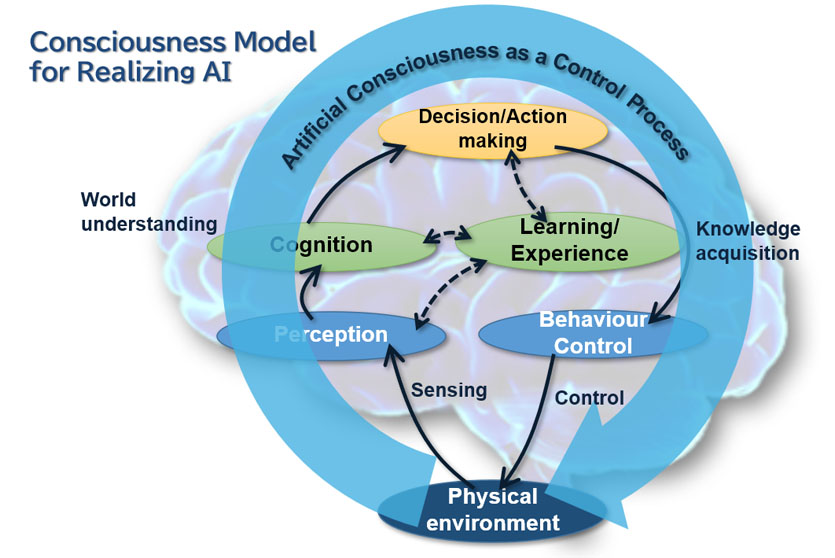
Deep learning and generative AI are currently causing drastic changes in our lives and in corporate activities. Take ChatGPT as an example. ChatGPT-4 was referred to as a “people-pleasing AI.” However, with the recent release of the revised ChatGPT-5, some describe it as having become “cold.” I believe the fundamental problem is that technological development is proceeding without current generative AI possessing a sufficient understanding of the mechanisms of “human cognition” or “human consciousness.”
Technologically, I expect the practical application of AI that surpasses human capabilities in various aspects to continue advancing across diverse domains. However, it is said that AI technology based on learning from massive amounts of data will eventually reach its limits as the data available for learning becomes depleted. Therefore, I believe the realization of conscious AI will be the next challenge for new AI technology. In other words, this means realizing “AI that understands the consciousness and emotions of the person right in front of it,” and based on that, “AI that supports human activities,” and above all, “AI that empathizes with people.” The domain of attentive services for people, in particular, is one that Japan needs and should be a strength of ours. However, since such initiatives do not necessarily align with current global R&D trends, I think it is necessary to intentionally set this as a direction for research in our country.
Cultivating startups capable of driving Deep Tech is a challenge
The Ministry of Internal Affairs and Communications has stated that Beyond 5G will be realized in the 2030s. How do you feel about the current situation and trends?
Murata:
Until 5G, I believe R&D has been driven by the aim of roughly reducing latency to one-tenth and increasing capacity tenfold with each generation, but I believe this linear growth model – operating on a logarithmic scale – is reaching its limits. It is important to think first about social applications and how to utilize high capacity and low latency, as well as how to utilize existing facilities. For 6G, holographic communication is often cited as a use case requiring even higher capacity, but of course, not all communication requires holograms. There are numerous technical challenges that cannot be realized by mere numerical improvements in communication capabilities, such as the advancement of application systems using digital twins, reliability improvement, and personalized services.
I believe technological innovations such as higher speeds, larger capacities, and the utilization of AI in networks will continue, but research targeting the consciousness of individual network users is uncharted territory. Assuming that we do not know what will come next as a new service, I think R&D on fundamental technologies that can respond to unpredictable developments is important. One example is flexible network configuration technology capable of adapting to various environmental changes to ensure reliability, encompassing even the cognitive domain of humans. I myself aim to solve this with a “network possessing artificial consciousness.”
What do you consider important for further utilizing the results of Beyond 5G research and development for the benefit of society in the future?
Murata:
As I have already mentioned, we should focus not on low latency, high capacity, and massive simultaneous connections, but on operational characteristics such as scalability, autonomy, safety, and low power consumption. We need to leverage these specific services such as ensuring connectivity in depopulated areas, communication during disasters, supporting telemedicine, and promoting the DX (Digital Transformation) of primary industries. We need to realize new services that overcome the high installation costs associated with base stations in 5G and Local 5G.
To that end, I believe it is necessary to foster startup companies that can drive Deep Tech (*). Startups excel at conceiving new business ideas, but in reality, few possess the capabilities to conduct technological R&D themselves. There are many startups that want to conduct new business utilizing 5G or Local 5G, but their understanding often remains at the level of “obtaining more stable communication compared to Wi-Fi,” leading to a mismatch with the technologies required in the field. Bridging this gap is an urgent issue.
*Deep Tech: Technologies with the potential to provide solutions to economic and social issues and have a significant impact on society.